
– The women we love to hate.
It’s easy to see why Melbourne’s Swinburne University promoted Aimee Stanton as one of their “pioneers for women.” She’s blond, lively, attractive and she’s a “celebrity”, having been a contestant on Australian Survivor and a presenter on a Channel 7 television program.
Most important of all, she’s a qualified female plumber – a very rare breed indeed. No wonder Swinburne couldn’t resist including her in many media stories, including their Stories for a Brighter Tomorrow promotion, with a whole page dedicated to this Swinburne alum who “survived and thrived as a lady tradie”.
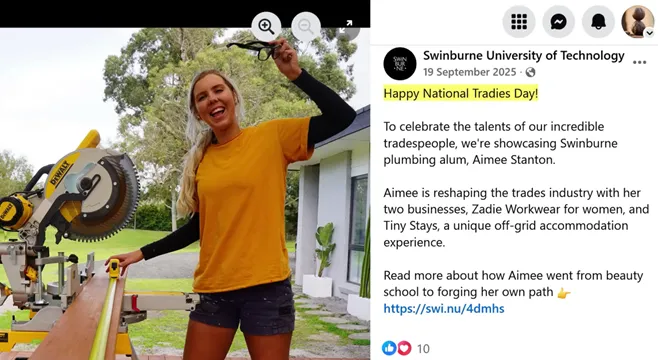
The university was obviously very happy to overlook Ms Stanton’s blemishes. Minor defects like being a self-confessed perpetrator of sexual assault.
Back in 2017, Stanton appeared on Channel 10’s now defunct TV show, The Project, alongside a panel including comedian Tommy Little. Midst great hilarity, Stanton asked Little if he remembered their previous encounter. It turned out that a few years earlier she had met him during promotion for her Survivor appearances and, as she put it, “groped his downstairs region” – apparently in response to a dare. He was very shocked – she was removed by security. Naturally the panel found this all a great joke and laughed off the whole incident.
Given that Swinburne makes a big deal of their zero-tolerance stance against sexual assault and harassment, a group of students has been rightly calling the university out for their hypocrisy and sexism. The ensuing correspondence with the arrogant administration was a “masterclass in bureaucratic deflection,” according to the YouTuber Daily Insight who documented the saga in two videos – here and here. It’s great to see he has attracted a large audience for these videos exposing the double standards of the university.
But that kerfuffle aside, what’s fascinating was Swinbourne’s willingness to take the risk of promoting Stanton – despite this tawdry history – because of her status as a lady tradie.
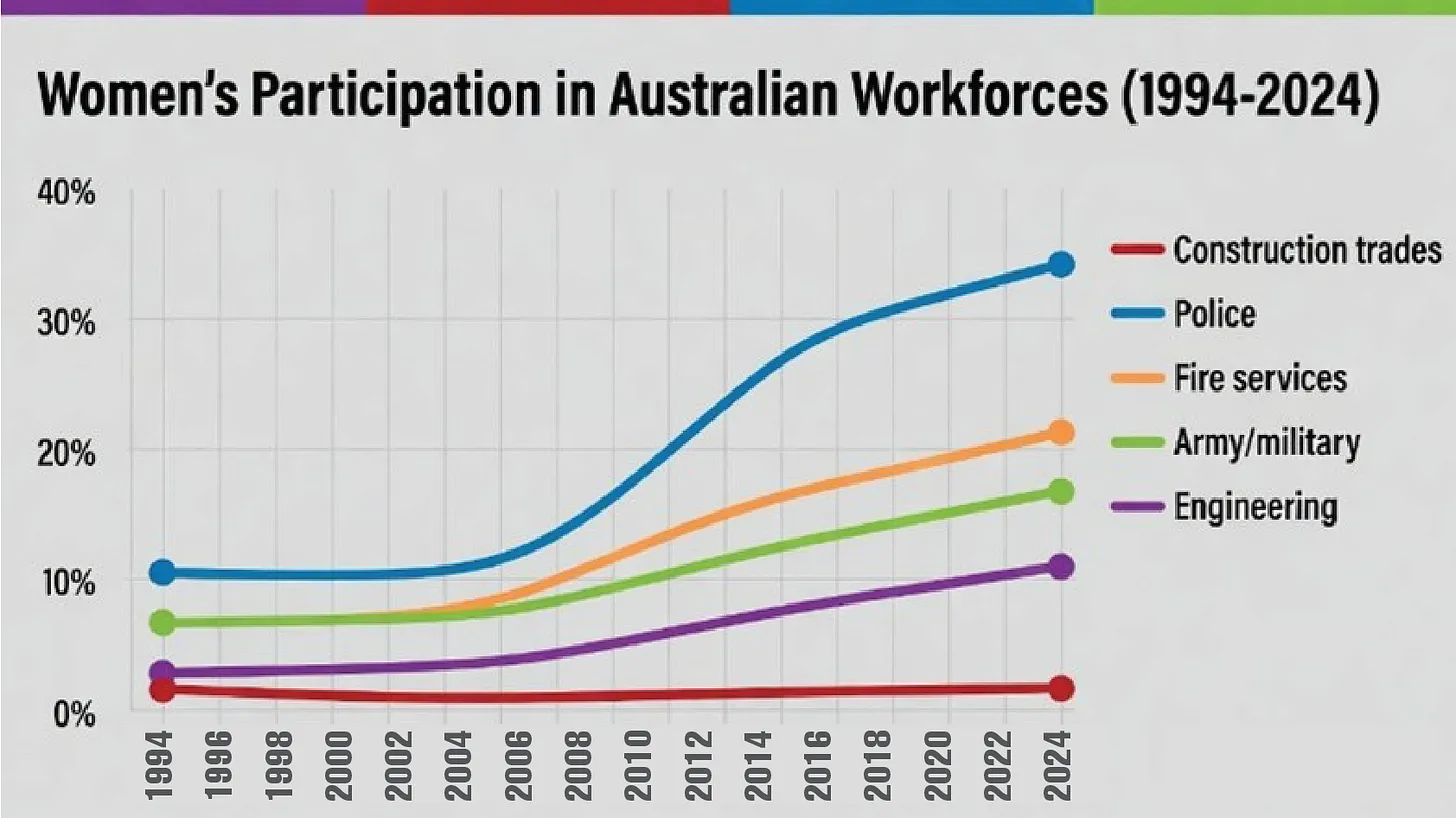
Take a look at this graph, which highlights the failure of our feminists to achieve growth of women in construction, as compared to a variety of other male-dominated jobs and professions.
No wonder the gender warriors of the ABC are tearing their hair out. Back in 2018 they published an article quoting various academics suggesting the government should do more to shake up “the boys club” and get more women into construction. The academics had done research into why this wasn’t happening.
Their brilliant conclusion? A particular problem was a culture of “presenteeism.” Construction apparently isn’t keen on people who don’t show up! “There is little tolerance for those who won’t commit, and part-time, shared or flexible work doesn’t exist,” lamented the academics.
And, they said, the problem is made worse by the “push to complete projects on time.”
Duh. You can imagine the reaction online when this article was published. Here’s one scathing tweet.

Late last year the ABC had another whine about the unreasonable demands of the construction industry… “long hours, early starts and rigid schedules” and suggested putting “gender on the tender” — meaning that companies competing for government jobs must fulfill gender equity quotas.
Well, that’s already happening, particularly in Victoria which requires women to make up 3% of trade positions in government projects over $20 million and the ACT which demands 10% female employment for government projects over $5 million. The federal government’s 2024–25 Budget introduced “gender-responsive procurement,” leveraging $330 billion in annual spending to promote equality—e.g., by favouring tenders with strong DEI plans.
Four years ago I wrote about the ACT government requiring successful tenders for the build of a new school to have a 100 per cent female management team on site. Given the dire problems of getting women into the construction trades, one solution is to push women into management and office/admin. Currently females handle 17% of such roles in the construction industry.
But the most visible and controversial women in construction are of course, the traffic controllers – those high-vis heroes of the roadworks universe, standing in the blazing sun or pouring rain, twirling their giant red-and-white lollipops like bored conductors of a very slow-moving orchestra.
In Australia we call the females of the species… the Lollipop Ladies.
Every time we drive past a roadworks site and see a couple of lollipop ladies standing around chatting on their phones or filming flirty TikToks, it’s not just a bit of everyday irritation — it’s a billboard for how we’re all getting fleeced.
Recently a book was published on The Dark Legacy of Daniel Andrews, which included a chapter on workplace relations by John Lloyd, who was the first Australian Building and Construction Commissioner. His section on construction in the Melbourne Metro Tunnel revealed traffic controllers are paid $126,200 but explained that’s only the beginning. Night and weekend work attracts double time rates, plus numerous other work entitlements adding a further $540 every week to the cost of employing a single traffic controller.
According to Lloyd, it’s all thanks to the construction unions, particularly the notorious Construction, Forestry, Maritime, Mining and Energy Union (CFMEU), now being “off the leash”. And that’s due to the Labor government repaying the critical electoral support of the unions by abolishing the Australian Building and Construction Commission (ABCC), which kept them somewhat under control.
Everyone knows about the thuggery of these unions, with widespread allegations of systemic corruption, stand-over tactics, bribery and extortion on taxpayer funded construction sites. Everyone knows such issues have driven massive cost inflation and major delays in major infrastructure projects, especially Victoria’s Big Build program. A recent investigation estimated CFMEU misconduct cost Victorians at least $15 billion.
The result is every time we drive past a roadworks site we see a couple of lollipop ladies standing around chatting on their phones or filming flirty TikToks, it’s not just a bit of everyday irritation — it’s a billboard for how we’re all getting fleeced. These casual roles, often filled by young women earning exorbitant salaries thanks to union-mandated penalty rates and overstaffing rules, are the most visible symptom of the CFMEU’s pernicious grip on construction.
While union corruption quietly siphons off billions from taxpayers behind the scenes, these highly paid, low-effort jobs sit right there in plain sight — a daily reminder that the same organisation inflating project costs to obscene levels is also propping up a workforce that looks more like a social-media side hustle than serious infrastructure delivery. No wonder people are furious: the lollipop ladies aren’t the problem, but they’re the face we see while the real rip-off happens behind the scenes.

Sometimes very glamorous faces, indeed. Look at these two, as featured on Australian social media. Here are their Tiktok videos…here and here. Of course, there are plenty of sensible women doing these jobs. But they too cop flak from an irritated public when drivers are late for work, stuck behind orange cones and forced to watch lollipop ladies chat on their phones, knowing they are earning so much more in a week than most qualified tradies.
“They are the women we love to hate,” was one of the headlines of one of the many media stories ranting about their huge wages. “Lollipop lady sparks outrage after revealing how much she earns in a typical week – and the eye-watering amount she’s paid for a 15-minute shift,” fumed the Daily Mail, discussing revelations from one traffic controller that she’d raked in $148 for just 15 minutes of work.
It’s not just the money. There are just too many of them. There are constant reports of overstaffing to meet union mandated minimums e.g., 2–4 controllers per site for shift rotations, even during quiet periods. Safety regulations require at least 2 controllers per high-risk site for safety (e.g., shift overlaps, breaks, or multi-lane coverage), even if traffic is light. This is the result of over-prescriptive rules from road authorities and work, health and safety regulators, falling over each other to pile on demands.
Australia proudly leads the world in over-regulating road traffic control, mandated by the government entities, such as VicRoads, Work Safe and councils. We boast roughly 40–60 traffic controllers per 100,000 people, roughly 2–3 times the rate in the United States, United Kingdom or New Zealand. Strict Austroads rules mandate human controllers on almost every moderate-to-high-risk site, often requiring 6 people or more per location.
The result? A very visible army of high-vis workers, many earning six-figure salaries with plenty of downtime. Yet there is no robust international evidence that this heavy-handed approach delivers fewer work-zone crashes or fatalities than countries that rely far more on signs, cones, portable lights, automated systems and common sense.
Well done, Australia—world champion in red tape and orange vests, and cost over-runs, with safety outcomes that look… pretty average.
There’s been a bunch of recent inquiries and reviews which have reached the same conclusion. The 2025 Traffic Controller Safety Survey by the Traffic Management Association of Australia, explicitly calls for accelerated rollout of digital speed displays, truck-mounted attenuators, and physical barriers, with a long-term goal to “remove all traffic controllers from live lanes” through automation.
But at the heart of this story is the great gender-diversity circus — DEI initiatives and shiny government quotas strutting their stuff, especially on taxpayer-funded projects. Sure, the real engine is still the fat pay packets, the infrastructure boom times, and a steady stream of backpackers willing to wave a lollipop sign for six figures… but let’s be honest: one reason you suddenly see so many young women holding stop/slow bats is so the big contractors can tick the “we hit our female quota” box and keep winning the next juicy government tender.
When it comes to ticking those boxes, it’s not the lollipop ladies who are actually making the difference. Women in traffic control make up roughly 1.5–3% of the total female construction workforce. It’s the female office workers and women in management who are really on the move –growing from 15% in 2023-4, to 50–55% in recent years. And to demonstrate how ideological this is, the majority of men in construction management have actual construction trade experience and qualifications, while almost none of the women appointed to these jobs do.
Fixing the lollipop lady problem—overstaffed, high-paid traffic controllers who are the most visible sign of waste in construction—means firstly going after the CFMEU by taking measures like deregistering or heavily restricting the corrupt construction divisions, stripping unions of their influence over traffic control accreditation and training. But also tackling the overemphasis on human controllers in government work, health and safety regulations, which are then imposed by builders, local councils, state road authorities and the like.
Meanwhile the rare, hard-working women who are out there learning the trades are often forgotten. Greg Cole runs NuForm Steel, a steel fabrication/installation company in Victoria and says that he, like many other business owners, is crying out for apprentices and would love to employ more women – if he could find them. But he needs kids who will show up – women suffering presenteeism problems aren’t an option.
I talked to one of his current apprentices, Naomi, 22, who’s in the middle of her 3-4 year apprenticeship in metal fabrication. When she left school there were plenty around her, including her parents, who urged her to become a lollipop girl – because of the money.
She chose the harder road. But it annoys her seeing the lollipop girls standing around, looking at their phones… “Damn it. It drives me a little nuts seeing them.” Yet she’s not sorry made the tough decision to plan for her future. “It’s a long-term vision.”